Sustainability
Sustainable Development Goal
Our sustainable development goal is “to deliver sustainable living for all societies with innovative solutions”. To achieve this, three sets of strategies were formulated based on our
“Good Corporate Governance” and “Value for the Future” foundations.
1.Innovation Leader to achieve sustainable growth
2.Eco-Efficiency Operations with minimal impact on the environment through efficiencies
3.Safety Awareness to promote the welfare and well-being
These strategies enables us to attract and retain talents who share the same values while offering transparency, fair treatment to all stakeholders and advocate anti-corruption practices.
To Deliver Sustainable Living for All societies, with Innovative Solutions
Stakeholder Engagement
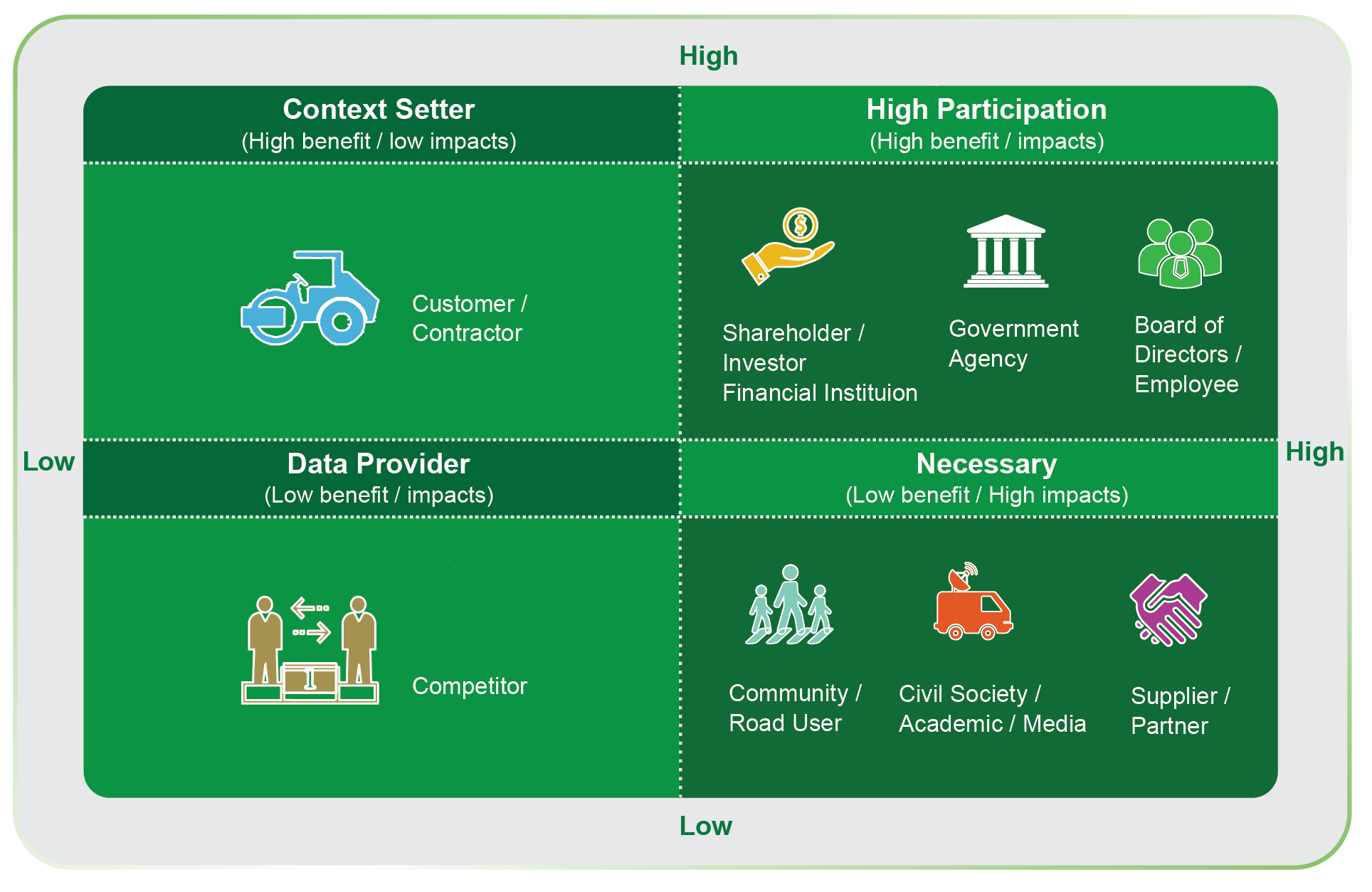
In order to successfully establish strong sustainable development framework, TIPCO Asphalt Group must understand and recognize mutual relationship and inter-dependencies between our businesses and related stakeholders, with high considerations to economic, social and environment. The Group’s business operations must respond to related stakeholder’s objectives and expectations. During SD framework development , the Group conducted a study on all stakeholders across our business value chain ,followed by Stakeholder Engagement activities. These allow our business operations to minimize potential adverse impacts while encouraging cooperation and creating shared values between the Group and related stakeholders and granted “license to operate” without their objections.
Policy : Stakeholder Engagement Policy


Stakeholder Identification and Prioritization
High
Stakeholder Influence on the Group’s activities
Context setter (High influence/ low impacts)

Shareholders/investors

Customers (contractors)

BoD/employees

Government agencies

BoD/employees
Data provider (Low influence and impacts)

Customers (contractors)

Competitors
Low
Necessary (Low influence, high impacts)

Civil societies/ academics/media
High
Stakeholder Impacts on the Group’s activities
Materiality Assessment
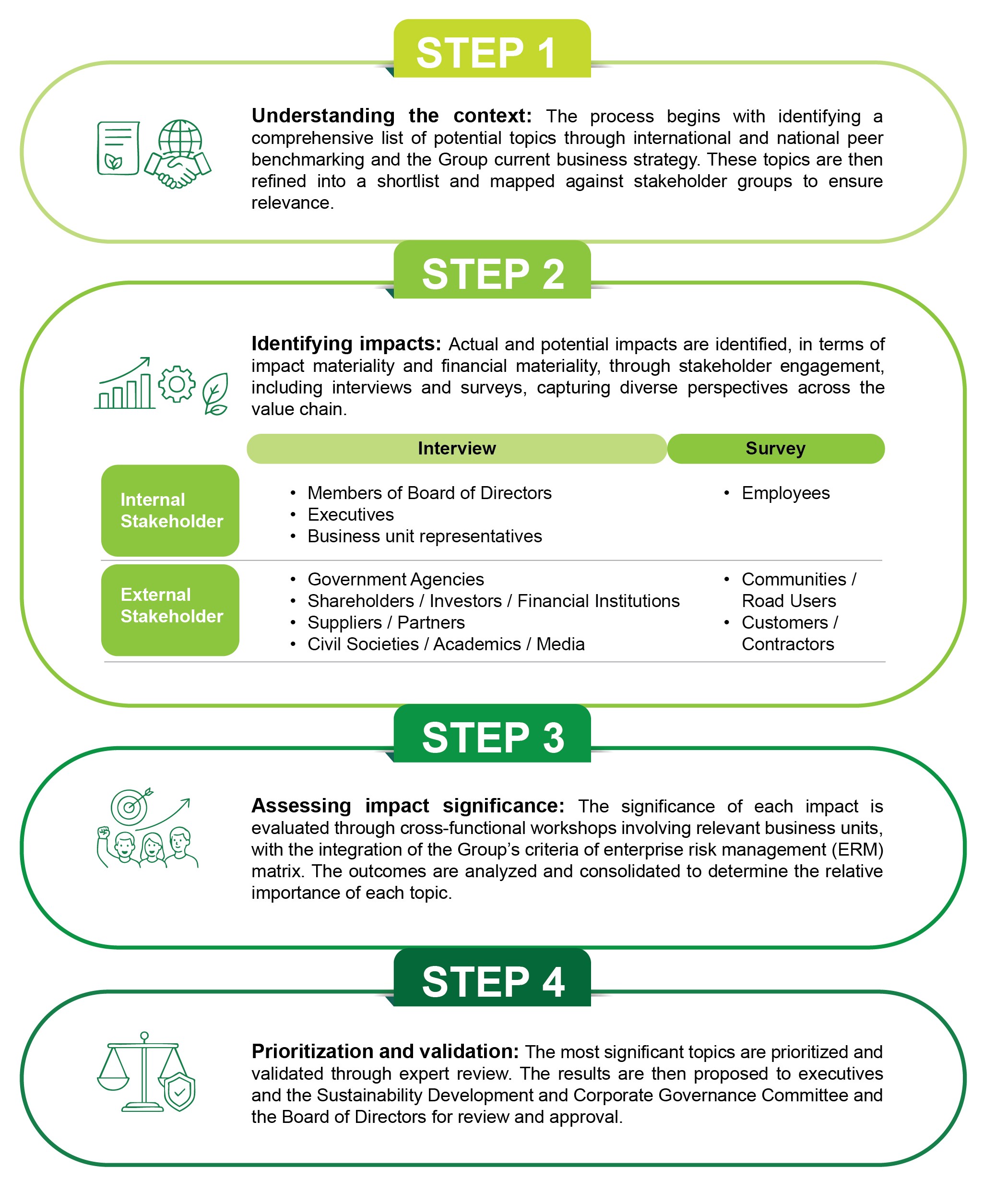
Materiality issues refer to economic, environmental or social related topics that are important to the Group as well as to key external stakeholders. The Group regularly conducts sustainability materiality assessment survey exercise to reaffirm the significance and relevance of these materiality topics while capturing potentially new materiality issues that might emerge from each survey. The sustainability materiality survey results will be carefully analyzed and prioritized based upon their relative influence on the Group and related external stakeholders, and whether these topics represent any potential risks or opportunities in relation to our business strategy.
Step of Materiality Assessment
1 Materiality identification
2 Interview
3 Assessment and prioritization
4 Result verification
Innovation Leader: For 10X exponential economic growth
8) Foster innovation for Tipco Asphalt DNA
10) Asphalt pavement excellence center
18) Environment friendly product and service development
Eco-Efficiency Operations : For better planet
2) Emissions management
3) Effluent and waste management/ spill and leak
5) Energy management
7) Climate risks and opportunities
15) Efficient use of resources/raw material
21) Protection of the environment, biodiversity and restoration of natural habitats
30) Water Management
Note: To improve eco-efficiency operations, capital investments, operating expenses, and estimated cost saving of relevant projects are Baht 22 million, Baht 4.9 million and Baht 3.6 million of, respectively in 2024.
Safety Awareness : Better safe than sorry
11) Occupational health and safety
13) Safety during transportation and goods delivery
19)
Health and safety for customer and road user
Good Corporate Governance : For strong business foundation
4) Risk & Crisis Management
6) Good corporate governance, transparency, and anti-corruption
9) News, Communication and corporate reputation
12) Politics/ government budget changes
16) Cyber security
17) Marketing and labeling
20) Customer centric
22) Customer privacy
23) Fair labor practices
24) Participation in community and society development
2ุ6) Dialogue with stakeholders
2ุ7) Fair business practices
2ุ8) Assessment of social, environmental, and ethical issues in the supply chain
2ุ9) Sustainable supply chain management
32) Sustainable Purchasing
33) Respecting Human Rights
34) Procurement from local businesses
Value for the Future : Be ready for change
1) Retaining potential employee and employee management
14) Training and education
25) Diversity and equal opportunity
31) Employee centric
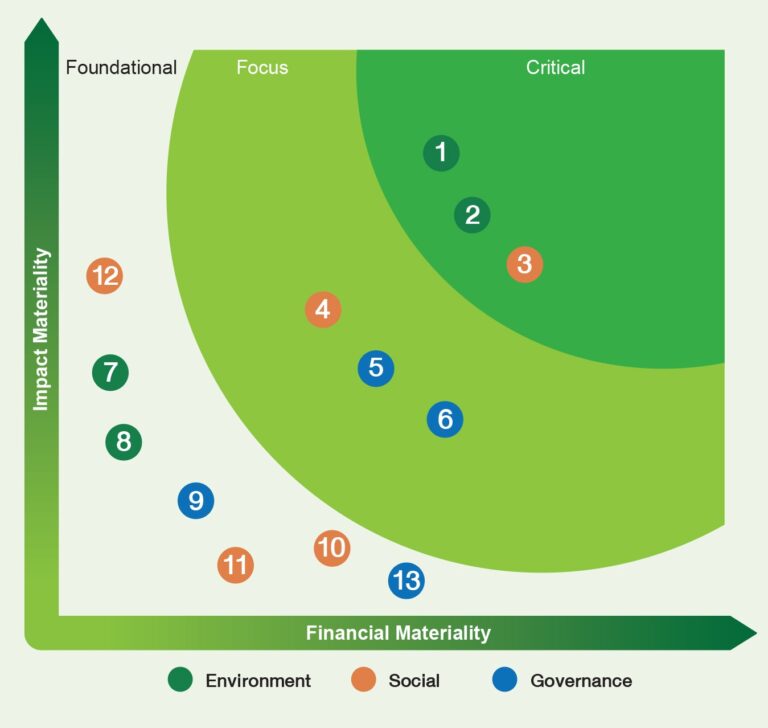
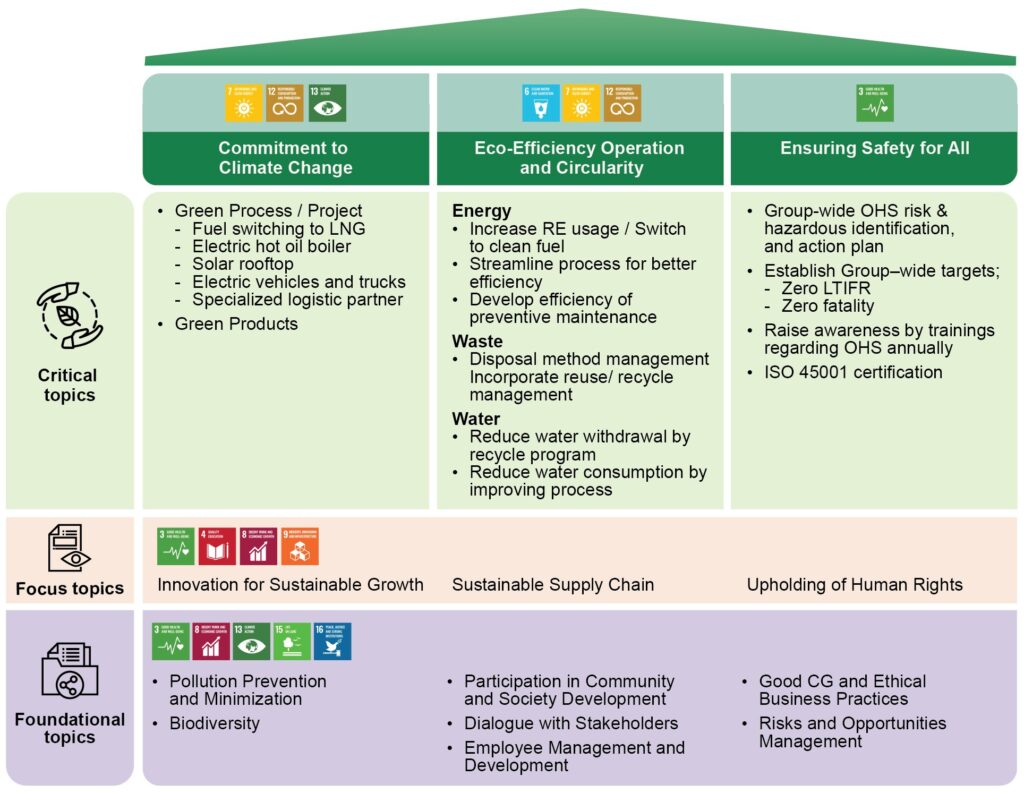
Result of 2021-2022 Materiality Assessment