Sustainable Supply Chain
Sustainable Supply Chain
INTRODUCTION
Stakeholder Impact
The Group’s sustainable supply chain practices aim to meet expectation stakeholders, particularly suppliers and business partners, across the entire value chain. These expectations require close collaboration on key ESG priorities, including climate change, human rights, and anti-corruption. As regulatory and market requirements become more stringent—such as the Green Public Procurement (GPP) Framework and the forthcoming Climate Change Act—these developments may create financial and operational pressures for stakeholders throughout the supply chain.
Without adequate regulatory guidance, these suppliers and business partners face increased costs to adopt new practices and may suffer financial instability, which in turn indirectly impact on the Group’s operational continuity and resilience.
MANAGEMENT APPROACH
Policies & Commitments
Practices
The Group commits to increasing the resilience of the supply chain, to mitigate potential cost of supply and regulatory disruption by integrating sustainability-related risk management (e.g., human rights, environmental impacts, and anti-corruption) into traditional procurement processes.
In response to this, the Group has initiated the ESG supply chain program (the Program) with the objective of managing the GHG emissions and other ESG risks from suppliers, extending beyond traditional procurement metrics (such as quality, price, production capacity, and delivery performance).
The Program has been approved by the SD&CG committee and overseen by the Board of Directors, and the procurement personnel (buyers) or relevant functions/internal stakeholders have been receiving necessary training on a regular basis.
The Program consists of four key steps, as follows:
1. Supplier Code of Conduct Acknowledgement
The Supplier Code of Conduct acknowledgement ensures that suppliers formally understand the Group’s ESG standards, strengthening compliance, transparency, and risk management across the supply chain while supporting responsible and sustainable business practices.
The Group has developed a set of baselines ESG expectations stated in the Supplier Code of Conduct. In turn, the Group engages critical suppliers to sign an acknowledgement of the Supplier Code of Conduct. (The critical suppliers are the raw materials and packaging providers who are integral to the Group asphalt production and delivery process).
2. Supplier Screening
To initially identify sustainability risks from suppliers, the Group has developed a supplier screening tool based on a desktop review. The screening tool consists of the following:
- Global research publications on climate change (environmental dimension), human rights (social dimension), and anti-corruption (governance dimension) across three different specific levels: country, sector, and commodity.
- Internal data regarding the calculation of supplier Scope 3 GHG emissions.
The output of this supplier screening tool classifies suppliers into high, medium and low sustainability risks. In turn, the high-risk suppliers are subjected to further scrutiny in the next step of the process: The supplier audit.
3. Supplier Audit
Following the supplier screening results, the Group developed the list of questionnaires, based on the Thai Labor Standard (TLS 8001-2020) and Supplier Code of Conduct, that covers three dimensions of environmental, social and governance. Such questionnaires are for auditing supplier concerning ESG risk.
The audit consists of a desktop assessment with evidence/document verification, and second-party audits, conducted either onsite or online. The Group then informs the suppliers of the audit results and, if necessary, provides recommendations for improvement. In addition, the supplier audit result is considered as part of annual supplier selection and evaluation phase.
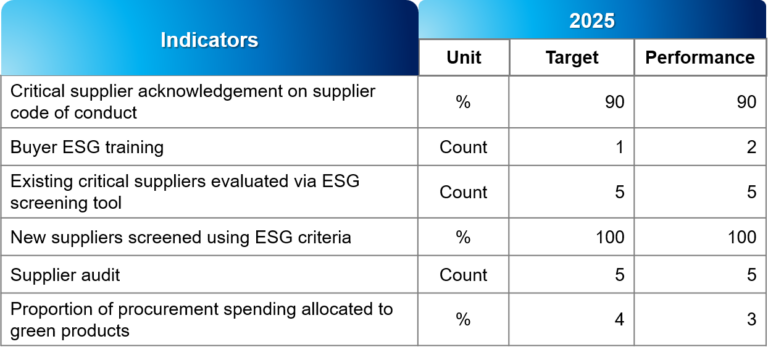
In 2025, the Group successfully conducted the supplier audits. Overall, suppliers demonstrated a strong baseline of compliance with the Group’s operational, environmental, social, and governance standards.
4. Supplier Capacity Building
The Group provides several capacity buildings initiatives for suppliers. These initiatives include sharing on sustainability-related information of the Group and providing in-depth technical support to build supplier capacity for specific areas (e.g., CPR and Green Industry level 5: the Green Network).
In anticipation of the upcoming Climate Change Act is on the horizon and the establishment of the Green Public Procurement Framework, the Group has implemented green procurement practices in place. Such practices aim to encourage the sourcing of raw materials and packaging products that are environmentally friendly.
KEY PERFORMANCE
HIGHLIGHT PROJECTS
Buyer Training
To ensure that our procurement team is equipped to execute appropriate supplier screenings and audits, the Group prioritizes specific training for purchasing personnel. This training aims to increase the procurement team’s capability to perform the ESG supplier audits and enable them to provide recommendations to suppliers
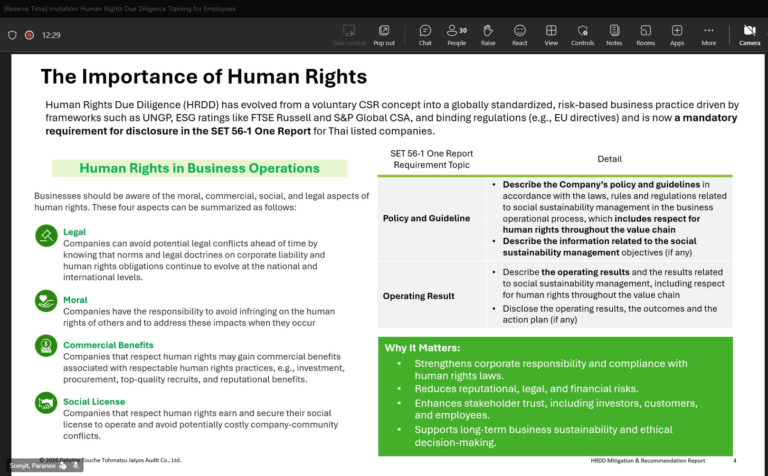
The Group conducted a human rights workshop for buyers’ understanding human rights concept and the Human Rights Due Diligence process, according to the United Nations Guiding Principles (UNGPs) on Business and Human Rights.
Green Industry
To foster a sustainable industrial ecosystem and support our supply chain partners in their environmental transition, the Group actively participates in and promotes the Green Industry network.
In 2025, production plants in Thailand have received Green Industry Certifications – level 5 (Green Network). These certifications demonstrate our Group’s effort to extend environmental responsibility to the supply chain.