Upholding of Human Rights
Upholding of Human Rights
INTRODUCTION
Stakeholder Impact
The management of human rights across our value chain creates profound impacts across stakeholders, including employees, suppliers, and communities. Not managing human rights risks effectively can lead to potential operational disruptions, and reputational damage. Conversely, proactive Human Rights Due Diligence (HRDD) process and maintaining accessible remediation channels drive positive outcomes by supporting employee productivity, elevating supplier ethical standards, and safeguarding community relations.
MANAGEMENT APPROACH
Policies & Commitments
Practices
The Group commits to upholding human rights and fair labor practices in business operations and value chain in alignment with the United Nations Guiding Principles on Business and Human Rights, aiming to mitigate the risk of human rights violations across the value chain.
Covering its own operations (asphalt business, refinery business, marine business, activities related to business (including supply chain activities), and new business relations (if any), the Group has established a Human Rights Due Diligence (HRDD) process in place, which is scheduled to be reviewed systematically and periodically.
The HRDD process consists of (1) Corporate Policy Commitment, (2) Identifying and Assessing Impacts, (3) Remediation / Disciplinary Action, (4) Monitoring and Whistleblowing Mechanism, and (5) Capacity Building.
HRDD Process
(1) Corporate Policy Commitment
As stated in the human rights policy, the Group “respects basic human rights and freedom inherent to individuals and is fully aware of human rights pertaining to all stakeholder groups”. The Group then communicates this policy to internal and external stakeholders, including employees and suppliers.
(2) Identifying and Assesing Impacts
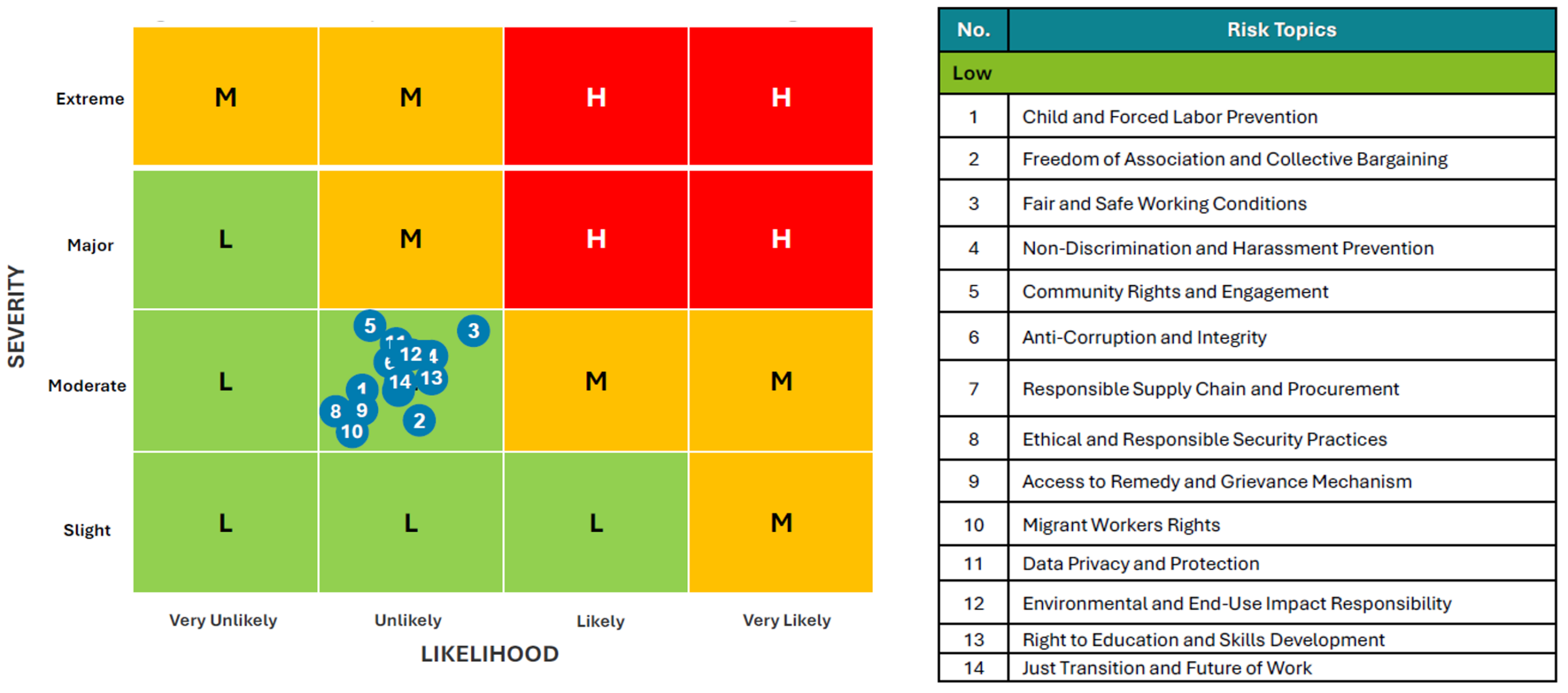
The Group has consulted with stakeholders to develop the list of relevant human rights issues (salient issues). Periodically, the Group assesses these salient human rights issues in terms of the impacts and likelihood. High-risk salient human rights issues require immediate attention (such as a prompt review of the current mitigations and the implementation of additional controls, if necessary).
(3) Remediation / Disciplinary Action
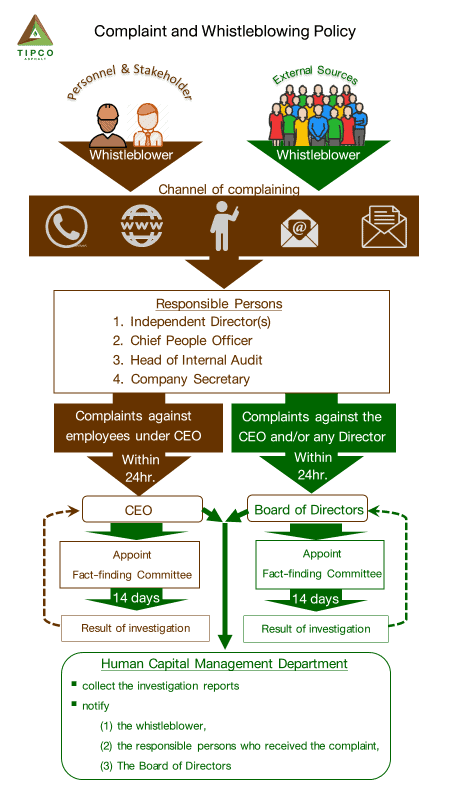
Once a case is reported or whistle blown, the Group shall conduct fact-finding in an equitable, impartial, and confidential manner, with strict adherence to the Group’s non-retaliation commitment.
We also commit to ensure that all remediation measures are victim-centered, prioritizing the rights, dignity, and needs of affected individuals. Remedies shall be timely, accessible, fair, and proportionate to the nature and severity of the harm.
When the case’s fact-finding is finalized, the Group also proceeds to execution of disciplinary actions against individuals within our organization, who violate human rights (if any).
With consultation from the Human Capital Management Department, the authorized management shall consider disciplinary actions based on the principles of good governance.
(4) Monitoring and Whistleblowing Machanism
The Group has the anonymous whistleblowing mechanism in place, managed by designated functions responsible for investigating incoming human rights cases. In addition, the Group provides procedural communication regarding the case through the whistleblowing mechanisms among relevant stakeholders.
(5) Capacity Building
The Group regularly conducts human rights risk training sessions for employees and the Board of Directors. These sessions aim to increase employee and other stakeholders’ awareness of the Group human rights policy and human rights in the business context, fostering collective action to mitigate the Group’s human rights risks.
To drive continuous improvement regarding human rights practices, Sustainable Development, Human Capital Management, Risk Management Office functions, and other relevant business units have joint responsibility to manage human rights performance, while the Board of Directors, Audit Committee and Sustainable Development and Corporate Governance Committee oversee the results.
HRDD Process Handbook
To formalize and integrate the human rights procedures into business practices, the Group has developed the Human Rights Due Diligence Process Handbook. The handbook offers standardized guidance to relevant functions to conduct human rights impact assessments.
On an annual basis, three specific inputs trigger human rights due diligence process workflow.
- The first input is the human rights-related initiatives. Functions to propose any improvement for human rights practices where appropriate.
- The second and third inputs are when there is a confirmed case of human rights violation reported or whistle blown; and/or when there is an issue of human rights from a result of supplier audit. The designated functions are not only responsible for proceeding with the cases in terms of remediation and corrective actions but also reviewing the human rights risk register and matrix accordingly.
Every three years, the Group executes a protocol to conduct a comprehensive human rights impact assessment, covering a desktop review of the industry’s and peers’ practices, stakeholder feedback on human rights, and recordable human rights cases from the whistleblowing channel.
In addition, the Group shall update the criteria to evaluate the human rights impacts (i.e., scale, scope and remediability) and likelihood, taking into account of all the rights holders and vulnerable groups, before conducting the evaluations with stakeholders.
KEY PERFORMANCE
HIGHLIGHT PROJECTS
Human Rights Training
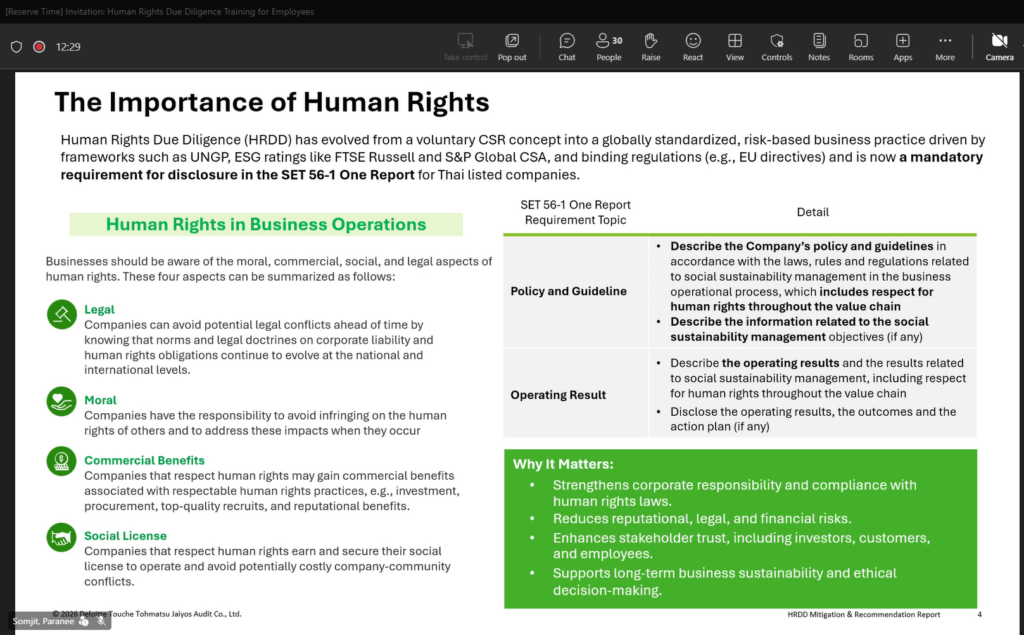
To increase employee capacity regarding human rights practices, the Group provided human rights training to selected employees involved in the Human Rights Due Diligence (HRDD) process.
In this training, the employees learned the rationales and core principles of HRDD and human rights risks, the basics of human rights, salient human rights issues relevant to the Group, and procedures for developing a human rights risk register and performing a human rights assessment.
Human Rights Assesment
After the human rights training, relevant business units developed the human rights risk registers for the Group’s salient human rights issues, taking into consideration all the rights holders (including all stakeholders of the Group), vulnerable groups, and existing mitigation measures.
In addition, Risk Management office and relevant business units jointly developed the assessment criteria, before conducting the human rights risk assessment of own operations, covering the asphalt business, refinery business, marine business, and activities related to the business including supply chain activities.
After factoring in mitigation measures, all salient human rights issues were assigned in low risk level.